
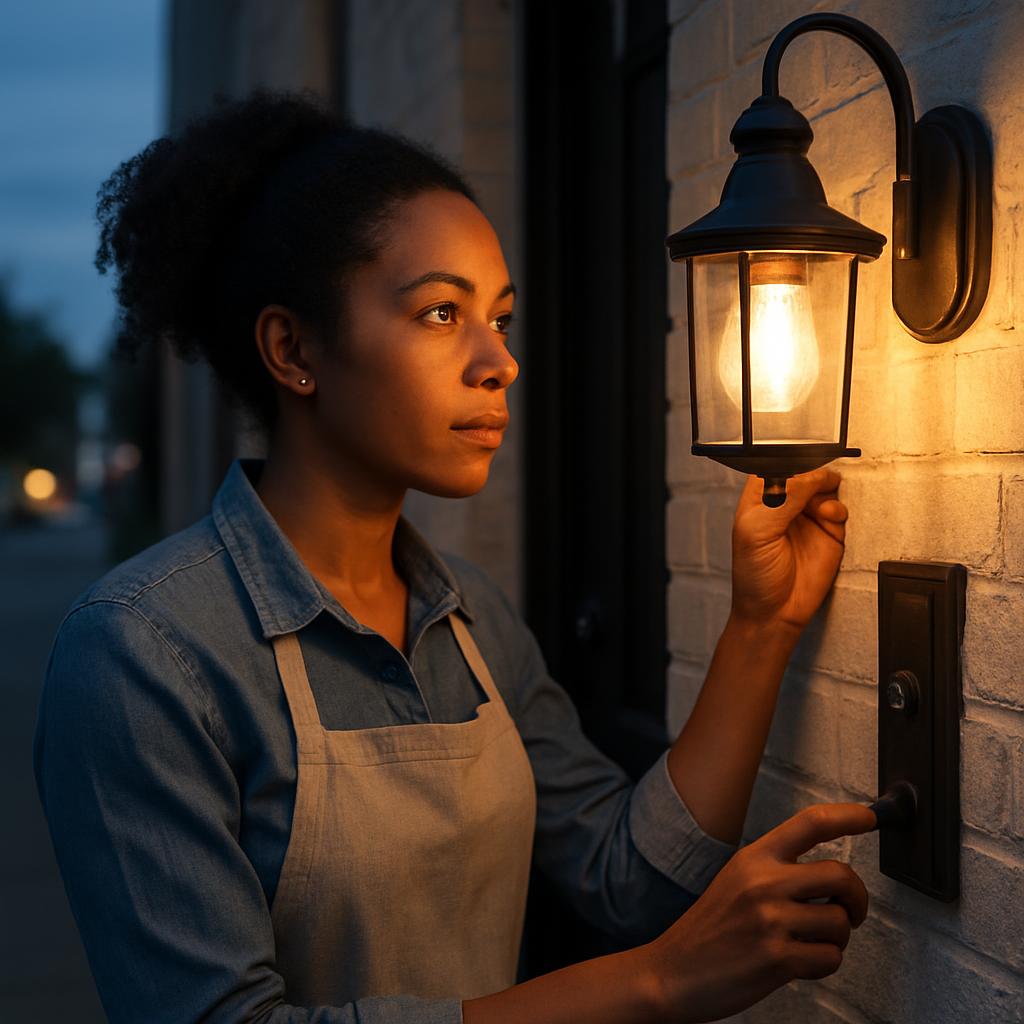
Physical security services protect small businesses by controlling who enters, monitoring key areas, and responding to threats. 14 of 22 experts put controlled access first, 12 of 22 experts recommend placing cameras on entrances and valuable areas, and 5 of 22 experts stress monitored alarms backed by a documented response plan for when something goes wrong.
The federal government's Ready Business program recommends the same starting point: assess your risks, protect your building and write down what everyone does in an emergency.
Key takeaways
- Control access first with rekeyed locks, key cards or codes—basic but more effective than expensive cameras monitoring the wrong areas.
- Walk your own property after dark and test every exterior door; if it moves, it's open, whatever the lock claims.
- Layer your security using multiple overlapping methods: locks, lighting, cameras and response plans work together better than any one alone.
- Document who responds when something happens and brief your team in writing; unclear responsibility creates gaps even with good equipment.
- Protect portable, sellable inventory more carefully than expensive fixed assets; thieves target what fits in a bag or truck.
Number of experts (out of 22) who made each point. Many made more than one.
We asked experts across manufacturing, retail, professional services, events and finance what physical security services matter most for small businesses. Their answers cluster around five themes: controlling access, detecting intrusions, responding to incidents, maintaining property and rethinking what 'assets' actually include.
1. Controlled Access and Basic Infrastructure
Access control—who can enter and when—emerged as the clearest priority. Experts advised rekeying locks, using codes or cards instead of keys, and regularly testing whether doors actually latch. Before you invest in cameras, get the basics right: our earlier expert roundup on the biggest security mistakes small businesses make covers the wider picture.
Alexander Kaplan, General Manager, Gotham Ride Chauffeur Service
“Access control you can change fast. Codes or key cards beat metal keys, because you can shut one off the day someone leaves. Cameras on doors, cash points and parking, plus a person who checks the footage.”
He emphasizes that monitored alarms require a clear response plan; a sounding alarm with no answer is useless.
Alexander Kaplan is general manager at Gotham Ride Chauffeur Service, a New York car service.
Sanket Desai, Co-founder, Charlotte Commercial Doors; Director of SEO & Chief Branding Officer, Spot Easy, Charlotte Commercial Doors / Spot Easy
“Start with the doors, because that's where I see businesses get hurt. I co-founded a commercial door company, and a lot of the service calls we get after a break-in aren't about a smashed lock — the door just never latched. So my order is boring on purpose: exterior doors, frames and closers inspected and kept latching properly first, then locks rekeyed or cores swapped every time someone with a key leaves, then lighting and cameras. My one tip: once a week, walk your own building after close and pull every exterior door. If it moves, it's open, whatever the lock says.”
He noted that many break-ins happen because doors don't actually latch, not because locks fail.
Sanket Desai co-founded Charlotte Commercial Doors / Spot Easy and is director of SEO at Spot Easy.
Michael Ligon, Strategic Capital Investor, The Ligon Group
“Rekey or replace every lock when you take over a space, because you never know how many copies of the old key are still out there. Put the exterior on timers or motion lighting, since a dark property invites exactly the attention you do not want. Then add monitored cameras at the entry points, not everywhere, with alerts that go to a phone someone actually watches.”
He recommends rekeying every lock on takeover, adding exterior lighting, and positioning cameras at entry points only.
Michael Ligon is a strategic capital investor at The Ligon Group.
2. Targeted Surveillance and Monitoring
Cameras matter, but placement and monitoring matter more. Several experts said cameras should focus on entrances, loading bays, cash areas and storage—not everywhere. Several noted that someone must actually watch the footage and respond, or cameras function only as evidence after the fact.
Josh Qian, COO and Co-Founder, LINQ Kitchen
“I would recommend a security package that secures a business during its most important and most vulnerable hours, particularly opening, closing, deliveries, and employee changeovers. Next, I'd look at mobile security patrols, monitored CCTV with remote access, panic alarms, and alarm response. If the business gets regular deliveries or has a high-value stock holding, then trained security personnel who can monitor loading bays, verify deliveries and deter potential criminals will be more effective than static cameras.”
He recommends starting with a professional security risk assessment before buying any equipment, and prioritizing trained personnel for high-value inventory.
Josh Qian is COO and co-founder of LINQ Kitchen.
Jimmy Wang, Founder, Yoofo Packaging
“Most small businesses buy cameras first and think about access last. In a factory, that's backwards. What works for us is boring: one controlled entrance for people, a separate gate for trucks, cameras covering the warehouse and loading bay rather than just the front door, and locked storage for dies, plates and client samples. My one tip: at closing time, walk your own site and try to reach your most valuable, most portable inventory without being seen or stopped. Fix wherever you succeed before buying anything new.”
He explained how his factory's real risk was portable stock, not the expensive presses, so he positioned cameras on the warehouse and loading bay, then tested access at closing time.
Jimmy Wang is founder of Yoofo Packaging.
Daniel Forrest, Senior Vice President, Video Business Development, Becklar
“It's important for most small business owners to prioritize a layered physical security strategy that includes elements such as controlled access, adequate lighting, security cameras, alarm monitoring—all with a clear response plan. Today, business owners are looking for a more proactive security solution. Becklar Video Remote Guarding offers a modern, proactive solution that combines AI-powered video analytics with trained remote security professionals who can identify potential threats, issue live audio warnings, and if needed, dispatch authorities. Video remote guarding is designed to deter potential threats before the damage is done.”
He describes modern video remote guarding, where trained professionals monitor cameras and issue live warnings or dispatch authorities.
Daniel Forrest is senior vice president of video business development at Becklar.
3. Procedures, Maintenance and Human Presence
Written checklists, regular property walks, and the presence of people matter as much as technology. Several experts emphasized that unclear responsibility creates gaps, that security is easy to overlook until something happens, and that a human presence deters better than equipment alone.
Nikita Khandheria, Founder & CEO, ERIA
“For a small business, I'd prioritize reliable locks and controlled key or code access, functioning alarms where appropriate, camera coverage of entrances and critical operational areas, and a documented procedure for who responds when something goes wrong. The most overlooked part is coordination. When a business has employees, vendors and guests coming and going, unclear responsibility can create gaps even with good equipment. One actionable tip: this week, walk your site as though you're a new employee and list every door, access code, camera and emergency contact. Assign one owner to verify each item works and document the results.”
She highlighted how coordination gaps emerge when employees, vendors and guests move through a space without clear responsibility for checking that doors work and cameras function.
Nikita Khandheria is founder and CEO of ERIA.
Bowen Khong, Sales & Marketing Lead, Aqua Luxe Pte. Ltd.

“People continue to underestimate the importance of having actual human security personnel to protect your business. Security guards are mainly for deterrence. In a huge percentage of cases, potential thieves and other troublemakers get deterred simply by the thought that there is someone watching the establishment. Security cameras and alarms are effective in each of their own ways, but they don't have the same unnerving effect of some other person potentially looking at you. I've seen far more establishments get robbed with security cameras than those with actual human security. It's just not the same.”
He argued that human security personnel deter theft more effectively than cameras because the threat of a sentient observer is psychologically stronger.
Bowen Khong is sales and marketing lead at Aqua Luxe Pte. Ltd.
Ardie Hollingsworth, Founder & CEO, Black 11 Entertainment
“Nobody was hurt — but one incident like that can end a brand you spent years building. Since then, security is a line item I never cut: licensed, bonded officers in adequate numbers at every live event, credentialed backstage access, and cameras at cash points. Tip one: Budget security in from day one — and before every event, walk the venue with your security lead and photograph every entrance, exit, and blind spot. Tip two: Brief your security team on customer service and on the vibe you're curating. Officers who know how to work with guests instead of over them protect the night without overpowering it — the event stays safe and secure, and nobody is put off by the sight of security at a high-end event.”
He learned that security needs to be budgeted from day one and that security staff should understand the client-facing culture they're protecting.
Ardie Hollingsworth is founder and CEO of Black 11 Entertainment.
4. Duty of Care and Liability
Physical security protects more than assets—it protects people and shields businesses from liability. Experts in law and business continuity stressed that unlighted areas, propped doors and unmonitored trouble spots expose businesses to injury claims and operational disruption.
Thom Pryor, Lawsuit Legal
“Small businesses should treat physical security as a duty to the people on their property, not just a theft deterrent. When owners fail to secure entrances, light parking areas and exits, or monitor known trouble spots, people can get hurt and it can expose the business to liability. My top tip: walk the property after dark like a customer or employee would and fix the first dark or hidden spot you find, whether that's a dim parking stall, a blocked exit, or a propped-open back door. Ignore a broken lock, an unlit lot, or a prior incident, and you're handing an injured person's lawyer the case.”
He emphasized that businesses that ignore broken locks, dark lots or propped doors can face liability if someone is injured, and owners may be handing a lawyer an easy case.
Thom Pryor is with Lawsuit Legal.
Wynecta Fisher, Consultant, LSF Enterprises
“When business continuity is important to your firm, there are several physical things that you need. You must have the ability to monitor your site remotely to reduce vulnerabilities. However the most important is Emergency Response Planning. You need more than a checklist, more than insurance and more than a downloadable form that you use prior to every storm season. You need to know who is the key personnel that enters the site after the event takes place to do an assessment prior to the adjuster's assessment. Recovering and getting back into operations is paramount.”
She stressed that business continuity depends on remote monitoring, clear emergency response plans, and designating key personnel to handle recovery before adjusters arrive.
Wynecta Fisher is a consultant at LSF Enterprises.
5. Specialized Assets and Overlooked Gaps
Several experts revealed security blind spots: garage door openers with factory codes, copier hard drives with documents, trash enclosures that invite trespassing, and portable equipment left vulnerable. Even specialized assets like crypto require physical storage security distinct from traditional building security.
David Yifrach, Owner, Seaside Garage Door Experts
“For a small business with a shop, a warehouse or a storage bay, the overhead door is usually the biggest opening in the building, and the weak spot I see most is the opener, not the lock. Customers call me because the door opens by itself, often at the same time every day. Usually someone nearby has the same opener model with the same factory code, and his remote opens their door without him knowing. On every new opener I install I reprogram the remotes and keypad to a unique code and never leave the factory one, and on a service call I reprogram it and the problem stops. One tip readers can use today: if your building has a garage or overhead door with an opener, have the remotes and keypad reprogrammed off the factory code.”
He found that many garage doors open by themselves because someone nearby has an opener with the same factory code, and reprogramming to a unique code closes the gap.
David Yifrach is owner of Seaside Garage Door Experts.
Abel Dominguez, CEO, ClearSite
“For most small businesses I'd put the trash enclosure near the top of the list. It sounds small, but it's one of the easiest ways for strangers to end up on your property after hours. Put a lock on the enclosure gate and only give keys to your staff and your hauler. Light it so it isn't the dark corner of the lot. Point a camera at it and post a sign that says so. If you wouldn't want to be back there alone, fix the lighting first. It's the cheapest fix with the biggest payoff.”
He pointed out that trash enclosures are gateways for trespassing and property damage, and simple locks, lighting and monitoring stop the pattern before it starts.
Abel Dominguez is CEO of ClearSite.
David Salamon, President and CEO, eCopier Solutions

“Doors, cameras, and alarm systems get most of the attention, and the copier rarely makes the list even though it's one of the most overlooked security risks in the building. Most business copiers have a hard drive that stores every document scanned, printed, or copied. When the machine leaves on a lease return or gets sold, those files can leave with it. Beyond that, lock the room where the equipment lives, require badge access, and set up secure print release so documents don't sit in the output tray for anyone to grab. The first step is to call your copier vendor and ask, in writing, what happens to the hard drive when the lease ends. If they can't answer, you've found something worth fixing before it costs you.”
He revealed that copier hard drives store sensitive documents and can leave the building on lease returns, and that operators should confirm in writing what happens to the drive at lease end.
David Salamon is president and CEO of eCopier Solutions.
More expert takes
Chongwei Chen, President & CEO, Data Recovery Expert, Software Developer, DataNumen Inc
“The most important physical security measures to invest in will be those that ensure your business can continue. Most small businesses see physical security as a way to prevent theft, but it is more about avoiding disruption to your business. An immediate measure you can carry out is to identify the 3 assets you wouldn't be able to operate your business tomorrow without. Ensure they have the correct physical security measures in place.”
He views physical security through the lens of business continuity—protecting the three critical assets without which operations stop.
Chongwei Chen is president and CEO of DataNumen Inc.
Kristie Tse, Founder & Clinical Director, Uncover Mental Health Counseling, PLLC
“Prioritizing physical security starts with understanding your unique vulnerabilities. Investing in high-quality access control systems is vital; I've seen firsthand how limiting entry points to only authorized personnel prevents potential breaches. Surveillance cameras with remote monitoring capabilities offer both deterrence and immediate oversight. Additionally, well-placed lighting around the property reduces blind spots and helps employees feel safer, especially during late hours.”
She recommends starting with a vulnerability assessment, then implementing access control, remote monitoring cameras and good lighting as an integrated system.
Kristie Tse is founder and clinical director of Uncover Mental Health Counseling, PLLC.
Amit Jhalani, Founder & CEO, True Sanity
“As a Jeweler in the trade for over 35-40 years, i do know security quite well. A safe, A 24 hour alarm service, a video continuous taped. We also have a jewelers block policy that covers us not only inside the office but also on the street. Buy and keep yourself insured.”
With 35-40 years as a jeweler, he prioritizes a safe, 24-hour alarm service, continuous video, and specialized insurance coverage.
Amit Jhalani is founder and CEO of True Sanity, a jeweler with over 35 years in the trade.
Tung Tu, Founder, PowerWashPal
“My one tip for any small operator: layer it. A coupler lock and wheel lock slow a thief down. A GPS tracker tells you where the trailer went. And one camera on the gate beats five cameras pointed at nothing.”
He recommends layered protection for mobile equipment: mechanical locks, GPS tracking, and focused camera placement rather than blanket coverage.
Tung Tu is founder of PowerWashPal.
Mim Obaidullah, Founder & Editor, ShopMartify
“For a business like mine, physical security isn't cameras on a wall. It's controlling which physical devices can reach the business. A small business should start with an access list: who can physically touch a device that can log in, and what happens if that device is lost or stolen. My one tip: once a quarter, walk your own premises — every laptop, phone and tablet that can log into your business — and remove admin access from any device you no longer control. It takes twenty minutes and closes a door no camera ever sees.”
He reframes physical security as controlling which devices can reach the business, and recommends quarterly audits removing admin access from devices no longer in use.
Mim Obaidullah is founder and editor of ShopMartify.
Benedict Martorano, Business Coach for Home Service Companies, Benedict Martorano, MBA Business Coach
“Most home service owners I work with will spend $40,000 on a truck and then protect it with a key hanging on a hook by the door. The three things worth paying for first are controlled access to the shop, cameras that actually record to the cloud, and a real inventory of tools and equipment with serial numbers logged — not from memory, in a spreadsheet. Locks and cameras matter less than who can get in after hours and whether you'd know what was taken. And don't forget the trucks themselves: a $200 GPS tracker on each vehicle beats a $2,000 alarm system you'll never arm. One concrete tip: photograph every tool and major part with its serial number the day you buy it, and store it offsite — if something walks off, that list is the difference between an insurance check and an argument.”
He noted that home service owners often protect vehicles poorly despite their value, and recommends controlled access, cloud-based cameras, and GPS trackers as cost-effective alternatives.
Benedict Martorano is an MBA business coach for Benedict Martorano, MBA Business Coach.
Kelly Ann Collins, Founder, SheCrypto
“If your business holds crypto assets, the physical security question is fundamental nowadays with the surge in AI-assisted exploits. The first step is to store your business assets in a cold wallet. Don't leave it on a hot wallet or exchange. Store it on a hardware wallet and keep it in your business's possession. Whether that be in a safe at your business or a deposit box at the bank. Have the recovery phrase stored somewhere else. Again, it should be paper or metal. Never on a photograph or digital format.”
She addressed crypto assets, where the physical security challenge is protecting seed phrases and recovery keys from theft or loss, not securing an office building.
Kelly Ann Collins is founder of SheCrypto.
Ioana Surdu-Bob, Konvi
“We use secure storage with restricted access and arrange insured transport through specialists. For example, when transporting a watch collection, we match the serial number to our inventory and ask for a signed receipt when the watch goes into storage. That gives us a record of which watch was received and who took custody of it. We require insurance across the board: for the journey, the final storage location, and anywhere the asset is held in between. If a shipment will spend the night at a depot, we need written confirmation that the cover applies there too.”
She described how businesses holding high-value assets use restricted storage, serial number matching, signed receipts and insurance across the transport chain.
Ioana Surdu-Bob works at Konvi.
Frequently asked questions
What physical security should a small business prioritize first?
Start with controlled access: rekey or replace all locks when taking over a space, use codes or key cards instead of keys so you can shut off access instantly when someone leaves, and test that every exterior door actually latches. Then add monitored alarms with a documented response plan and strategic camera placement on entrances and valuable inventory. Lighting comes next, followed by written procedures and staff awareness.
Are security cameras enough to protect a small business?
No. Cameras show what happened but do not prevent it. They are most effective when combined with controlled access, good lighting, alarms with response plans, and a person who actually monitors the footage. Many break-ins happen because doors do not latch or are left propped open, not because cameras failed. Human presence or the threat of presence deters crime better than equipment alone.
How often should a small business walk its property for security problems?
Regularly, and after dark. One expert pulls every exterior door once a week after closing, and others walk their site at closing time to look for dark spots and inventory a stranger could reach. Regular walks catch problems like worn door closers or burned-out lights before they turn into break-ins.
What happens if we do not have a security response plan?
Unclear responsibility creates gaps even when you have good equipment. Staff should know whom to call, where guests can safely exit, and which areas are restricted. A monitored alarm is useless if no one answers the call or knows what to do next. A written checklist designating who checks doors, cameras and lighting at opening and closing makes security routine rather than something people only consider after an incident.
Should small businesses hire security guards or rely on technology?
A human presence deters better than technology alone because potential thieves are unnerved by the thought of another person watching. However, most small businesses balance this by using controlled access and cameras as the main layer, with security personnel hired for high-value inventory, events, or after-hours presence. Budget and risk level determine the right mix for each business.
The bottom line
Physical security services for small businesses are not about expensive cameras or elaborate systems. They are about controlled access through rekeyed locks and changeable codes, monitored alarms with clear response plans, strategic camera placement, adequate lighting, and regular property inspections. Start with a professional security assessment to identify vulnerabilities before buying equipment. Build procedures so everyone knows their role, test that doors actually latch, protect portable inventory as carefully as fixed assets, and walk your property regularly after dark to spot gaps before intruders do. Experts from manufacturing, retail, professional services and events all agreed: the basics—a door that closes, a light that works, a camera someone watches, a lock someone can change—prevent most problems far better than advanced technology installed without a plan.
Responses were collected through a media query in November 2026 and have been lightly edited for length. This article is general information about physical security considerations and is not a substitute for professional security assessment, legal advice or business continuity planning tailored to your specific situation.