
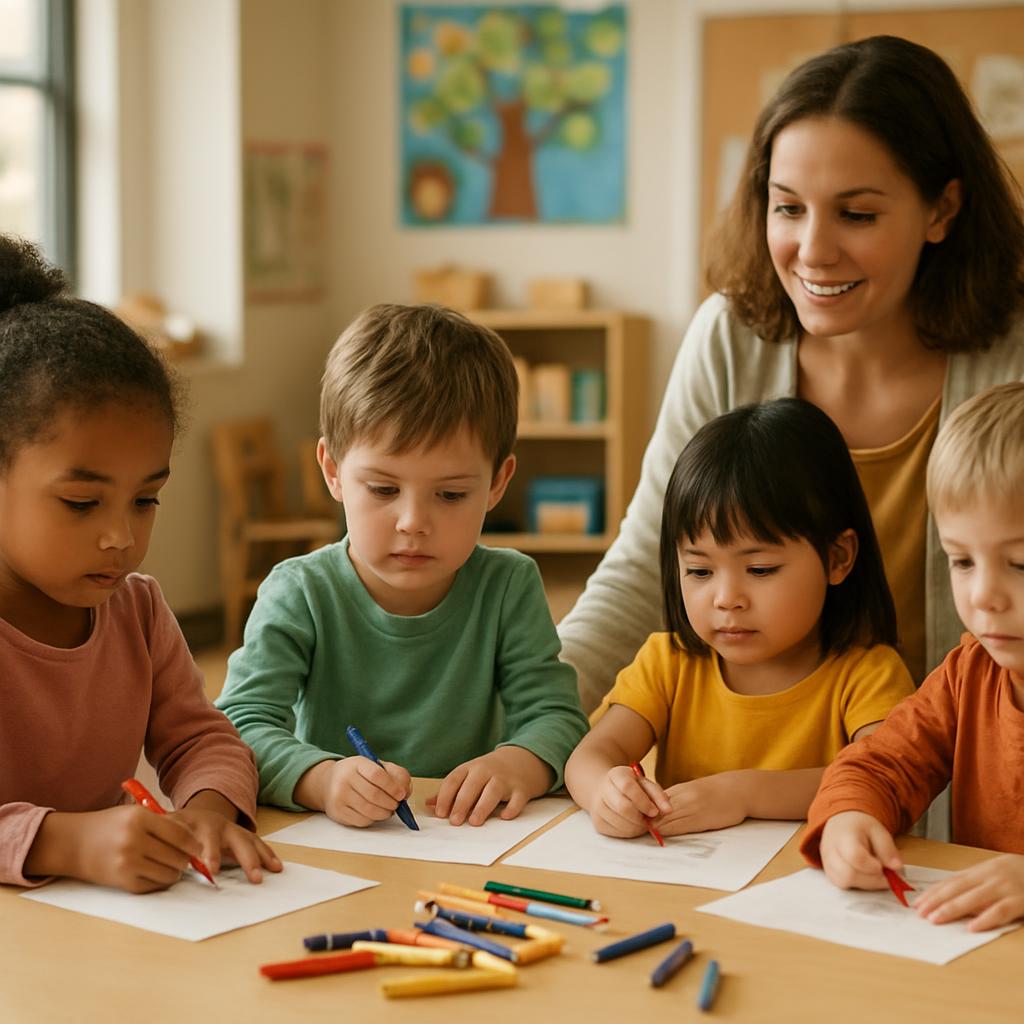
A kindergarten calm-down bin is often a tub, pencils, and spare paper. In the 2014–15 school year, the National Center for Education Statistics found that 94 percent of public school teachers spent their own money on classroom supplies, about $479 on average. For PreK and kindergarten, a free printable coloring page still does real work: no student account, no login, and no fee.
Why the page belongs in the plan
In PreK and kindergarten, coloring is a fine-motor lab: tripod grasp, boundaries, and midline crossing on a large drawing. Those skills later support handwriting. Head Start's Early Learning Outcomes Framework treats perceptual, motor, and physical development as its own domain, not a filler between "real" lessons. Closed shapes are finishable when one adult cannot sit with every child.
After a loud transition, a familiar page and a short timer settle a child without a screen. The work is quiet, visible, and easy to end when there is no sensory-kit budget.
What it does not require
Paid shops assume a teacher can pay and open an account. Many cannot, especially where one copier is shared and a new vendor waits on a privacy review. A page saved once and copied all year removes the cart, the login, and the question of who gets the "premium" pack.
The claim stays narrow: a printable still needs paper, a copier, and a choosy adult. When the barrier is price, not paper, no-cost pages close a gap paid packs leave open, and a sheet in a backpack needs no tablet or password.
AI drafts, human standards
Image tools make a sheet in seconds, which helps an empty closet, but speed is not fitness for ages four and five. Broken outlines, tiny details, clutter, and odd anatomy are common. If only some rooms have time to repair the file, the tool widens the gap it was meant to shrink.
Treat generated art as a draft. Before a class set, check that shapes are closed, lines are thick enough from a lap, the scene is not a stereotype, and the terms allow classroom use. If it fails, do not print it.
Hand-drawn pages still belong in that check. Illustrators working in 2026 who add a small story and a little humor give children a reason to talk, not only to color. A joke a five-year-old can see — a cat in the wrong hat, a bus missing a wheel — supports oral language beside the hand work. The test is the page, not a brand: does it invite one sentence?
A center routine that costs nothing
Write one purpose in the bin: strong fingers with short crayons and large shapes, or color and then say one sentence. Ten restocked pages beat fifty random ones. Repeat pages so children build control.
Teach the routine once: choose a page, write a name, color until the timer ends, then the finished tray. Talk about the picture; do not grade it. A free page fails if it becomes another ranking tool.
Offer a half sheet to children who tire, and clip paper for left-handed children. Home note: "Color together and tell one story. Any colors are fine." Do not ask families to buy markers.
Skip ads in the drawing, paid-club codes, characters you cannot legally copy, dense mandalas that make this age quit, and files that demand a child's email address just to open a picture. Adult mandalas frustrate, then get abandoned, which teaches the opposite of persistence.
A coloring page will not fix staffing, and it will not replace read-alouds, play, or direct teaching of letters. With a purpose and a short quality check, it protects fine-motor time and a quiet center after the budget is gone: no account to start, and an adult can see the work.
ChiChi writes about early-childhood materials and classroom access and is part of the Huebloom team.