
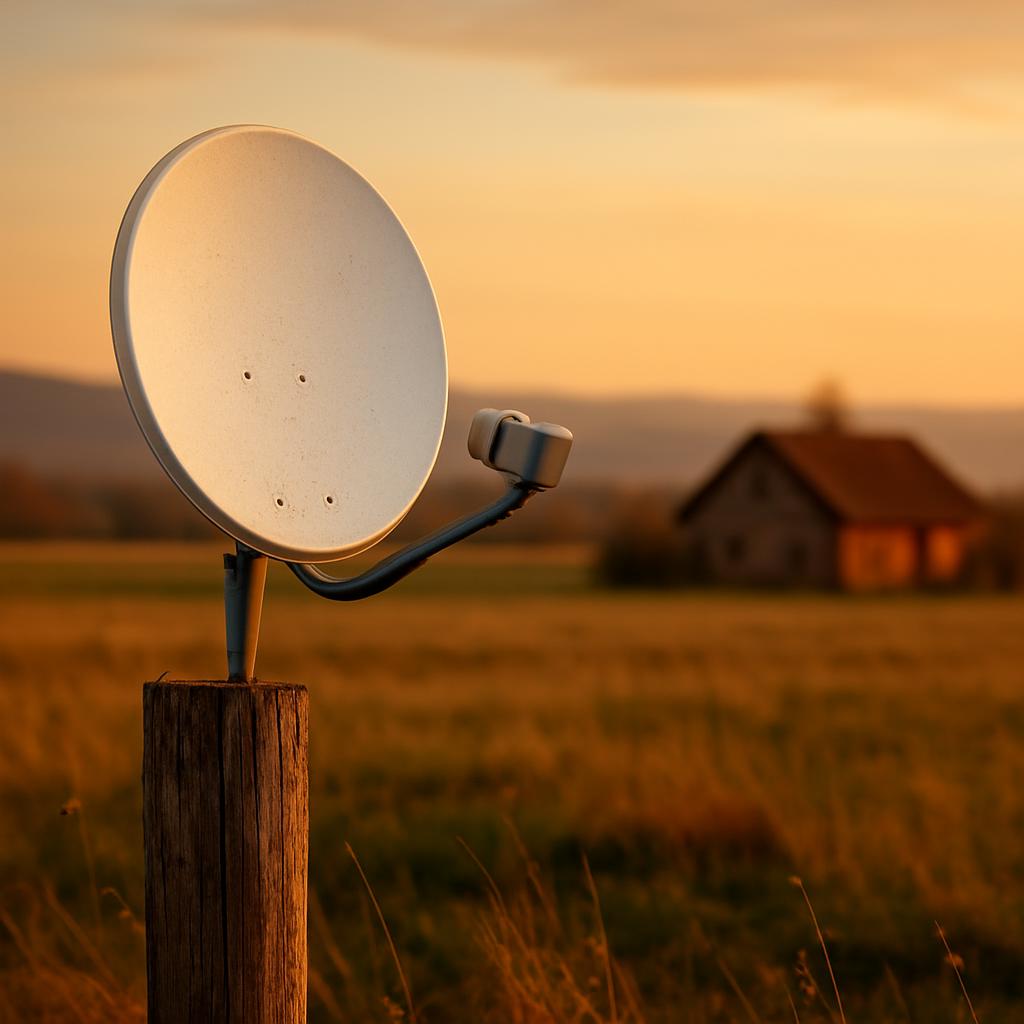
Yes. Satellite internet now reaches almost every corner of the globe, from fishing villages in Alaska to small islands in the Pacific, though the speed, price, and reliability you get depend heavily on which provider serves your area and how crowded that network is. Low-orbit networks like Starlink and older geostationary services like Viasat and HughesNet have turned satellite from a last-resort option into a real alternative for places cable and fiber never reached. For rural counties, farms, and small towns stuck with slow DSL for decades, that shift has changed what's possible for remote work, telehealth, and school.
Key takeaways
- Satellite internet now covers most populated parts of the world, including many remote rural areas with no cable or fiber option.
- Starlink's low-orbit satellites usually beat older geostationary services on speed and lag, but mid-band 5G can still win in cities.
- The widely quoted $55-a-month Starlink price is a promotional or regional plan, not the standard nationwide rate.
- Viasat still has an edge in some fixed business and maritime plans, but most home users get better performance from Starlink.
- Rural schools, farms, and emergency responders are among the biggest beneficiaries as satellite coverage keeps expanding.
How does satellite internet work, and where can you get it?
Satellite internet works by sending your data from a dish at your home up to an orbiting satellite, which relays it to a ground station connected to the regular internet. That ground station passes the request on to the wider internet, and the response travels back the same way, through the satellite and down to your dish. The whole trip happens in a fraction of a second, though the distance the signal travels changes depending on how high the satellite orbits.
- Your satellite dish sends a request for a webpage, video, or app data.
- The signal travels up to a satellite, either in low orbit (about 340 to 1,200 miles up) or geostationary orbit (about 22,000 miles up).
- The satellite relays the signal to a ground station linked to fiber internet lines.
- The ground station fetches the data from the internet and sends it back up to the satellite.
- The satellite beams the response back down to your dish, usually within tens of milliseconds for low-orbit systems and several hundred for geostationary ones.
Low-orbit networks like Starlink use thousands of smaller satellites instead of a handful of large ones, which cuts down the distance signals travel and lowers lag. This is one reason satellite internet has gone from a niche backup option to a genuine choice for people in places where no cable company has ever laid a line. Farms, mountain towns, and coastal communities that once relied on slow or capped connections can now get service closer to typical home broadband.
Coverage still has gaps. Some countries restrict or haven't approved Starlink and similar services for regulatory reasons, and very high-latitude or ocean regions can have thinner satellite coverage at certain times of day. Readers in a specific area should check a provider's official coverage map before assuming service is available, since maps are updated as new satellites and ground stations come online.
Is Starlink faster than 5G?
It depends on where you live: Starlink usually beats 5G in rural areas, but strong mid-band 5G in cities and suburbs can be faster and steadier.
Starlink typically delivers download speeds in the range of 100 to 250 megabits per second, with latency around 25 to 60 milliseconds, which is fast enough for video calls and most streaming. Mid-band and high-band 5G, where available, can push speeds well above that, but coverage is spotty outside cities and often drops once you're indoors or far from a tower, as explained in this breakdown of why 5G signals struggle to reach through walls.
The comparison also depends on network congestion. A rural household on Starlink with few neighbors sharing the satellite may get a smoother connection than someone on a crowded urban 5G tower during peak evening hours. For a broader look at how 5G performs against other home internet choices, this 2026 comparison of 4G and 5G breaks down when each makes sense.
Neither technology is universally faster. The honest answer for most readers is to check actual coverage maps and, where possible, ask neighbors or local forums what speeds they're really getting, since marketing numbers describe best-case conditions, not guaranteed ones.
Is Starlink really only $$55 a month?
No, not for most people. The $55 figure usually refers to a specific promotional or entry-level plan in certain regions, not the standard price everywhere.
Starlink has offered a cheaper 'Residential Lite' tier in some markets, along with regional discounts in areas where demand is low and the network has spare capacity. Standard residential plans in many countries run noticeably higher, and users also pay an upfront hardware cost for the dish and router, which has ranged roughly from $200 to $600 depending on the kit and country.
| Plan type | Typical monthly range | Notes |
|---|---|---|
| Residential Lite | Lower-cost tier | Slower speeds, available in select areas |
| Standard Residential | Mid-range | Most common home plan |
| Priority/Business | Higher | Better speeds during congestion |
| Mobile/RV | Mid to higher | Usable while traveling, no fixed address |
| Maritime | Highest | For boats, includes ocean coverage |
Because Starlink uses demand-based pricing, the cost can shift by region and even by neighborhood as the company tries to balance how many users share each satellite's capacity. Anyone quoting a flat $55 figure is likely referencing a limited-time offer or a specific country's lite plan, so readers should check the official pricing page for their exact address rather than relying on a number seen online.
Is Viasat or Starlink better?
Starlink is generally better for speed and lag, while Viasat still holds an edge in a few specific situations like fixed business sites and certain maritime or aviation contracts.
Viasat relies on older geostationary satellites, which sit much farther from Earth and cause higher latency, often 600 milliseconds or more. That lag makes video calls and online gaming noticeably less responsive than on Starlink's low-orbit network. Viasat's advantage is capacity in specific, already-built beams, which can mean more stable service for business customers with a long-standing contract in a covered area.
| Factor | Starlink | Viasat |
|---|---|---|
| Typical latency | 25–60 ms | 600+ ms |
| Typical download speed | 100–250 Mbps | 12–100 Mbps |
| Orbit type | Low Earth orbit | Geostationary |
| Best for | Streaming, calls, gaming | Fixed business sites, some maritime plans |
| Data caps | Generally none or soft caps | Often has hard data caps |
HughesNet, another geostationary provider, competes mostly on price in areas with no low-orbit option yet. For most households weighing the two main names, Starlink wins on everyday performance, but a reader in a very remote area should still check whether Starlink has active capacity nearby, since a Viasat plan already running can sometimes be more reliable than a Starlink waitlist.
What are the benefits and drawbacks of satellite internet?
Satellite internet's biggest benefit is reach: it can serve places no cable, DSL, or fiber line has ever touched, which matters most for rural and remote communities.
- Wide availability: works in rural, mountainous, and island areas with no other broadband option.
- Fast setup: a dish can often be installed in a day, compared to months of waiting for a new cable line.
- Useful during disasters: satellite kits have been used for emergency communication after hurricanes and wildfires when ground networks went down.
- Line-of-sight sensitivity: trees, hills, and tall buildings can block the dish's view of the sky and cut speeds.
- Weather interference: heavy rain or snow can temporarily slow geostationary and, to a lesser extent, low-orbit signals.
- Upfront cost: hardware fees can be a barrier for lower-income households compared with signing up for existing cable service.
For local governments and schools, satellite internet has become a practical stopgap while fiber expansion projects are still being built out. A rural clinic offering telehealth appointments or a school running online testing can now do so without waiting years for a utility crew to run cable down a county road.
The drawbacks are mostly about consistency rather than total failure. A storm might slow a connection for an hour rather than cut it off entirely, and dense tree cover can mean a dish has to be mounted higher than expected. These are manageable issues, but they explain why satellite internet, even at its best, isn't always a perfect replacement for a wired connection in town.
What's next for satellite internet coverage?
Coverage is expanding fast, with more satellites launching regularly and new competitors entering the market, which should push prices down over time.
Direct-to-cell satellite service, where a phone connects straight to a satellite for basic texting without any special equipment, is rolling out through partnerships between satellite companies and mobile carriers. This matters most for rural and disaster-prone areas, where a dropped cell tower during a storm could otherwise cut off emergency communication entirely. Amazon's Kuiper network and other new entrants are also beginning to launch satellites, which should add competition to a market that has mostly been a two-way race between Starlink and the older geostationary providers.
Regulators in many countries are still working through spectrum and licensing rules for these newer services, which affects how quickly they become available in a given region. Readers who live in an area still waiting on approval should expect timelines to shift as negotiations continue, and should rely on official provider announcements rather than general news coverage for a firm launch date.
For most communities, the practical result over the next few years will be more choice and, likely, lower prices as low-orbit networks mature and new players compete for the same rural and remote customers who have waited the longest for reliable internet.
Frequently asked questions
Does satellite internet still work during bad weather?
Usually yes, though heavy rain or snow can temporarily slow the connection, especially on older geostationary systems like Viasat and HughesNet. Low-orbit networks like Starlink handle weather better because the signal travels a shorter distance, but a severe storm can still cause brief slowdowns.
Can you use Starlink while traveling, like in an RV or on a boat?
Yes, Starlink offers mobile and maritime plans designed for use away from a fixed address, though they typically cost more than the standard residential plan. Coverage and speed can vary depending on how many other users are sharing capacity in that area at the time.
Is there a data cap on satellite internet plans?
It depends on the provider. Starlink generally doesn't impose hard data caps on residential plans, while Viasat and HughesNet plans often do, with speeds reduced after a certain amount of monthly usage.
How long does it take to install a satellite dish at home?
Most self-install kits, including Starlink's, can be set up in a few hours by the customer without a technician visit. Geostationary providers like Viasat sometimes require a professional installer, which can add a few days to the process.
Will satellite internet eventually replace cable and fiber in rural areas?
It's likely to remain a strong option rather than a full replacement, since fiber still offers higher reliable speeds where it's available. Satellite's main role will likely stay focused on areas where running physical cable is too costly or slow to justify.