
5G can't easily penetrate walls because its fastest tier of service relies on very high-frequency radio waves, known as millimeter waves, which behave more like light than like traditional radio signals. These short wavelengths carry huge amounts of data quickly, but they are also easily absorbed, scattered, or reflected by solid objects such as brick, concrete, glass, and even human bodies. The result is a signal that excels in open, line-of-sight conditions but weakens dramatically indoors or around obstacles.
To understand why, it helps to compare 5G to older cellular technologies. 4G and earlier networks mostly use lower-frequency bands, generally below 6 gigahertz. These longer wavelengths can bend around corners and pass through walls with only moderate signal loss, which is why older phones often get decent reception deep inside buildings. 5G networks also use some of these lower and mid-range frequencies, and those portions of 5G behave similarly to 4G in terms of wall penetration.
The dramatic difference appears in the millimeter wave portion of the 5G spectrum, which operates at much higher frequencies, often in the range of 24 gigahertz and above. At these frequencies, wavelengths shrink to just a few millimeters, roughly the size of the materials they encounter in everyday construction, such as glass panes, wood studs, and insulation. When a wave's size is close to the size of an obstacle, it interacts with that obstacle far more strongly, either bouncing off, being absorbed, or scattering in multiple directions rather than passing through cleanly.
This physical property is a direct tradeoff for speed. Higher frequencies have more room for data because there is more available spectrum bandwidth at those frequencies, allowing carriers to transmit far more information per second. Carriers chose millimeter wave specifically because it can support extremely high data rates in short bursts, useful for dense urban areas, stadiums, or specific hotspots. But the same physics that unlocks that bandwidth also makes the signal fragile over distance and against obstacles.
Weather and environmental conditions compound the issue. Millimeter wave signals can be weakened by rain, foliage, and even humidity, since water droplets in the air are similar in scale to the wavelength itself and absorb or scatter the signal. Combined with poor wall penetration, this makes millimeter wave 5G primarily practical for outdoor, short-range deployments rather than a blanket replacement for indoor coverage.
Carriers address this limitation by using a mix of frequency bands rather than relying solely on millimeter wave. Low-band 5G, sometimes marketed as extended range or nationwide 5G, travels farther and penetrates buildings much like 4G, but with lower peak speeds. Mid-band 5G offers a middle ground, providing a reasonable balance between coverage and capacity, and has become the backbone of many commercial 5G rollouts because it performs adequately both outdoors and indoors. Millimeter wave is reserved for high-demand, high-density locations where enormous throughput matters more than broad coverage.
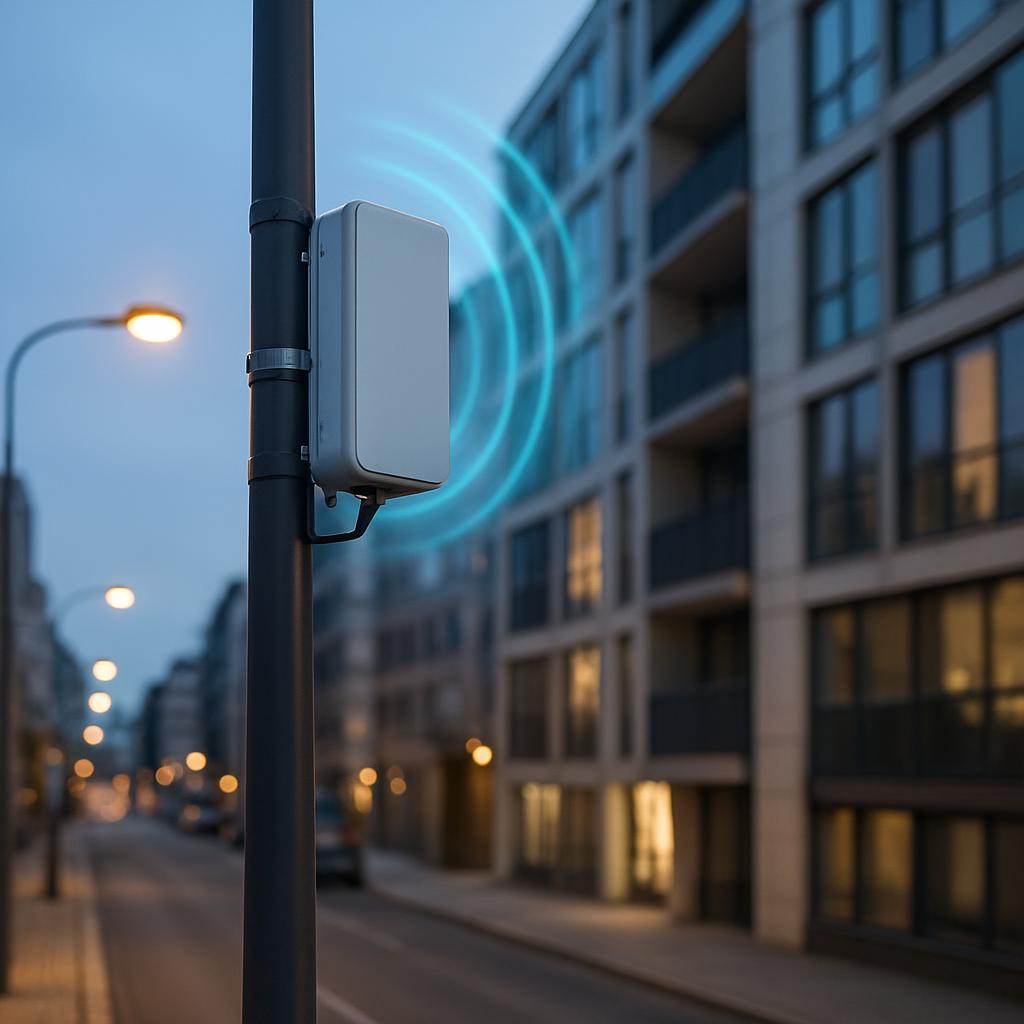
To compensate for millimeter wave's limited range and poor building penetration, network operators deploy many small cells rather than the fewer, larger towers used for lower-frequency signals. These small cells are compact antennas mounted on light poles, building facades, or bus shelters, placed close together so that users remain within a short line-of-sight distance from a signal source. This density helps offset the physical drawbacks of high-frequency transmission but also makes millimeter wave 5G more expensive and complex to deploy at scale.
Building materials play a major role in how much signal loss occurs indoors. Modern construction methods, including energy-efficient windows with metallic coatings and reinforced concrete, can block wireless signals even more effectively than older materials. This means a 5G signal that performs well outside a building may drop sharply the moment a user steps inside, regardless of the frequency band being used, though the effect is most extreme with millimeter wave.
Some carriers and equipment manufacturers address indoor coverage gaps with dedicated indoor systems, such as small in-building antennas or signal repeaters, particularly in large venues like airports, offices, and shopping centers. These systems essentially bring the outdoor signal inside through a wired connection, sidestepping the wall-penetration problem entirely rather than trying to force a high-frequency signal through solid barriers.
In short, 5G's wall-penetration issue is not a flaw so much as a predictable consequence of the physics involved. The technology that enables blazing-fast speeds inherently trades away the ability to travel far or through solid objects. Network planners work around this by layering different frequency bands and deploying infrastructure more densely, but the fundamental limitation remains rooted in how radio waves interact with matter at very short wavelengths.